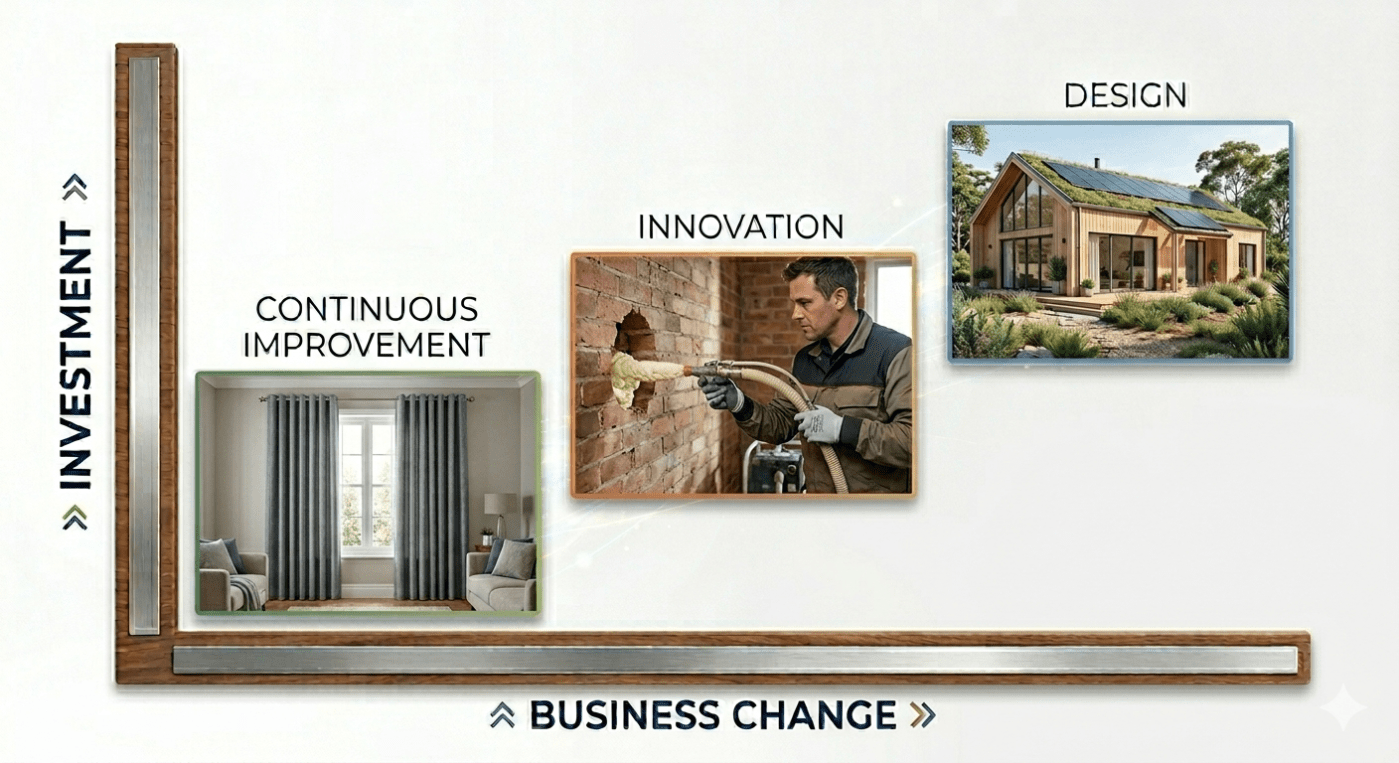
Innovation is about change, but it is, of course, not the only business function concerned with the improvement of an organisation. The growth in awareness of Continuous Improvement techniques underpinned by the Lean Six Sigma methodology means many corporations are setting up their own, with impressive results at super-low costs. And the world of design has countless methodologies, processes and standards to govern its output. So where does Innovation fit in?
There’s an analogy I like to use that has the example of household insulation. Unless you live in a very hot country, keeping your home warm through the seasons, especially the colder ones, is something you’ll be familiar with. It neatly illustrates how corporate innovation sits between continuous improvement and design, as follows:
Continuous Improvement: closing the curtains
A major facet of the Lean Six Sigma methodology is removing waste from a process. Often, this can be achieved at no cost at all. If it’s cold outside, closing your curtains helps keep heat in and prevents any drafts from windows. It’s an effective example of continuous improvement because it provides benefit for no money; a change can be noted simply by doing something different.
Innovation: cavity wall insulation
So you’ve closed all your curtains, plugged all the drafts in the windows, doors and walls and put a jumper on to stay warm at home. Your easy-to-access, cheap or zero-cost improvements are now exhausted. For any kind of measurable benefit beyond this, you’ll need to do something very different, and this is where technology comes in. Innovation is not always about technology, but in today’s modern world, it’s seldom without it. The application of foam-based cavity wall insulation can yield help reduce heat loss from your home, thereby both keeping you warmer and saving money; the most successful innovations typically have more than one major benefit. The downside is that investment is needed and you can’t easily apply the insulation yourself. But your home otherwise looks the same, only with better insulation.
Design: the super-eco home
To reach a point at which heat loss from a building is reduced to the absolute minimum available by modern human-made technologies, there’s only one way to achieve that – by design. You “design out” the issues and drawbacks of traditional homes to super-insulate your property. At the highest level – with the biggest budget, of course – you could use a ground source heat pump to reduce the cost of heating your home too. Today, you’ll only really find examples like this in truly bespoke, custom houses. Those that we so often see on Channel 4’s Grand Designs.
These three tongue-in-cheek examples have been positioned on a chart. On the X-axis we have business change, where a higher value generally means more benefit and the furthest departure from the norm. The Y-axis is cost, with an ascending value indicating that more investment is required.
In business change, you’ll need to select the best vehicle for your needs. It’s why, occasionally, when people in my organisation approach me to discuss a new technology, if all the benefits are clear, well-understood and proven by other customers, you may not require an innovation process to evidence benefits; it can go straight to design. Similarly, don’t make things more complicated than they need to be. A method analysis of a business process could yield savings quite easily. For everything else, you have an innovation process.
 Digital Is Not Rocket Science
Leave a comment