Hands up if you’ve ever used a transport mode of any kind, and found that for reasons beyond your control, you’ve had to research and select an alternative option, most likely using your smartphone? Yep, we’ve all been there.
Frustratingly, for all the travel booking apps we have access to from our phones, the burden of fixing your current travel predicament nearly always falls to the customer. Operators will no doubt claim they do their best to help, but they may be absent in-person, unreachable online due to demand or, as is so often the case, place an automated chatbot between you and them to try and resolve the problem.
Operators will no doubt point to reliability and punctuality as leading reasons why investment in service recovery is, in my view, too low. The regular services where customers never have to interact with their operator are the bread and butter of their incomes and so understandably, the importance of getting this right is a priority. But, when your customers are left abandoned on a station platform or airport terminal with their travel plans cancelled, the greater negativity expressed at the moment is considerably higher than any gratitude that a regular service arrived on time. Those passengers were just lucky.
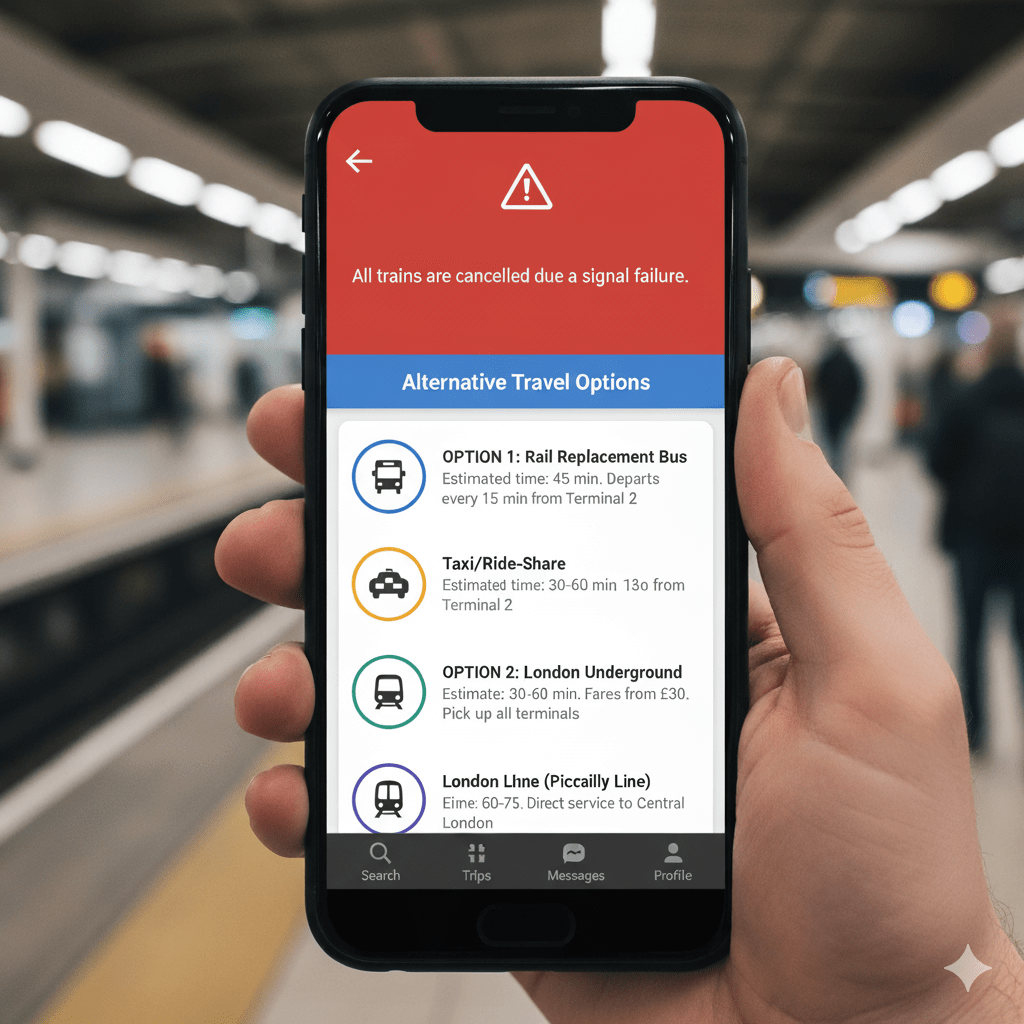
Service recovery is grossly overlooked and yet with the combination of today’s AI and operational data availability, it really needn’t be. What happens when the best-laid travel plans go awry? Customers open up their phones. So let’s use that medium: the operator will know that the booked service is cancelled and who is on it, could send a notification to the customer to draw them into an app where an official update on their situation is shown followed by a set of AI-generated options for selection. These options could be as extensive as the customers prefers.
Let’s consider a real-world example of how this might work, based on my own experience about four years ago when travelling from London Paddington to Swansea for a conference. On arrival at Paddington, the signage boards showed that our service was cancelled due to a fatality on the line near Maidenhead, and that trains between Reading and Paddington were suspended. My colleague at the time knew that there was a service between Waterloo and Reading we could use, so we walked back to the tube, headed to Waterloo, found the service we needed and although we waited about an hour at Reading, we found an Aberystwyth service calling at Swansea (that ultimately terminated there anyway). Looking back, there was absolutely no better alternative that day from what we selected, but it was based on a colleague’s own knowledge and our own research along the way.
The perfect service recovery solution would be first to notify us that our service was cancelled in advance of arriving at Paddington. True, we could – and maybe should – have checked, but didn’t, and only discovered the problem on arrival at Paddington. An SMS would be fine if the app isn’t installed, which, like everything in this example, the train operator would know about me. The notification or SMS draws me into the app (or mobile website) and starts by detailing the disruption and what it means for me based on what the operator currently knows.
Then, the clever bit: use AI to work out my alternative options. Google Maps does this point-to-point route-finding impressively already and offers modal options too. So the best alternative might be to use the tube (or bus) to Waterloo, connect to Reading and then pick up my Swansea service there. An Uber taxi option might be presented, if I have to be in Swansea at any cost. Later trains in the schedule could also be shown if the disruption wasn’t expected to last all day. Refunds and compensation could also be offered. I can tap an option that best suits me, tickets get automatically rebooked (or refunds issued) and that’s one less complaint the operator has to handle.
The difference between providing these options and researching them is reducing or removing the burden from the customer. They’ve already paid for a service which, refunds notwithstanding, isn’t going to be delivered and it should not be left to the passenger to rescue the situation themselves. Let’s do better.
 Digital Is Not Rocket Science
Leave a comment