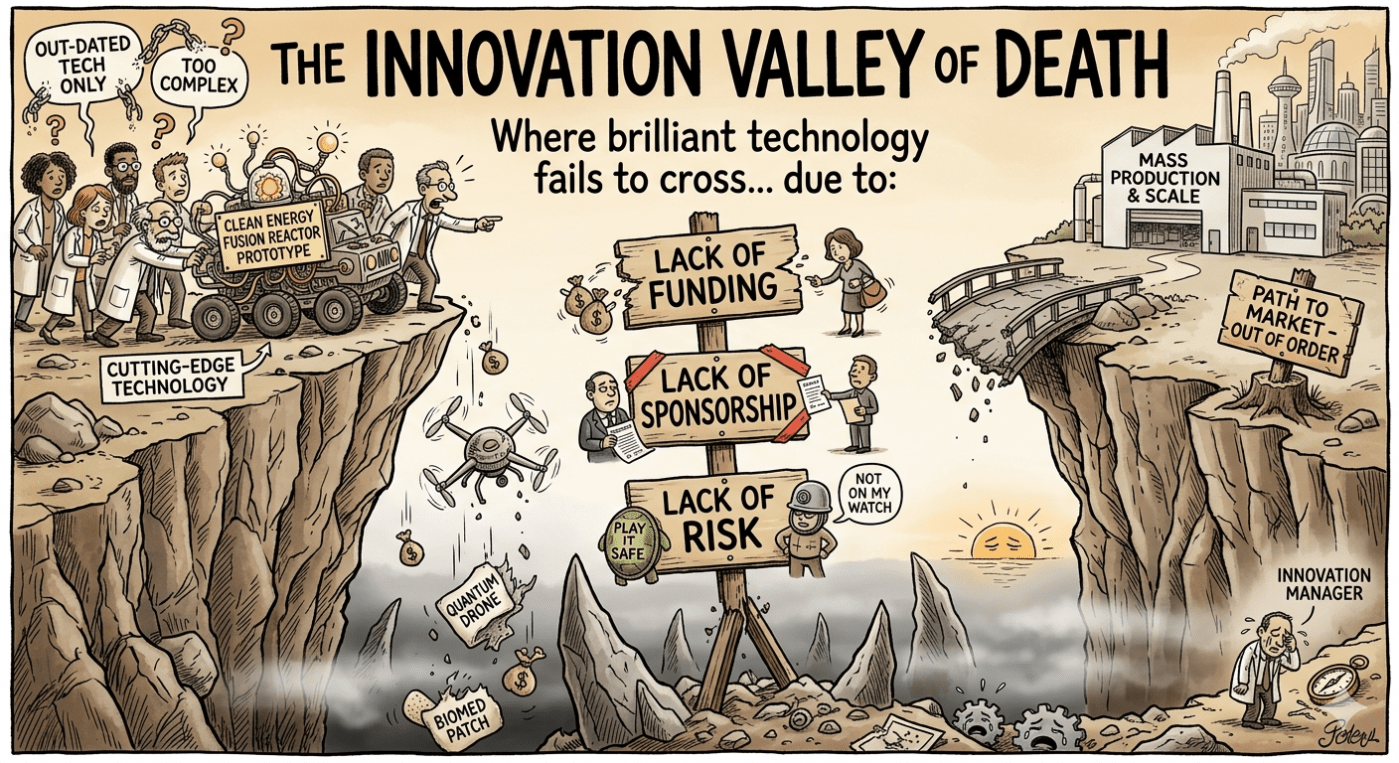
The hardest part of the Innovation process is the scaling up process. It’s known as The Valley of Death for a reason: you’ve delivered a trial with promising results that met all (or most) of its objectives, your sponsor is chomping at the bit to get it installed and the supplier emails you every week for updates. Gartner doesn’t call it the Trough of Disillusionment for nothing. Welcome to the Valley.
The Valley of Death is characterised by the need for outturn funding, sponsorship, risk and duration. Getting the funding right can be trickiest of all, because, as we know, the trial evidences the benefit, highlights the risk and, critically, tells the story. Some technology, such as AI is so abstract that it is hard to bring to life the benefits. But even then, a successful trial may not be enough to meet the business-as-usual requirements and this is where many innovations get stuck. There is definitely promise but to reach a business-as-usual (BAU) solution, you might need more to comfort stakeholders and your funding owners. This is where the pilot comes in.
A pilot is a trial on a larger scale. It should be fully project-managed and led by the teams who stand to benefit or receive the new capability, while Innovation leads can keep a hand in progress to keep everything on track as well as sharing the heritage of learnings from the original trial. Even better, the pilot can be scaled straight into BAU if it is set up correctly; for example, getting your vendor into a contract with perhaps a 12-month break (if it doesn’t work out) means you can roll on if things are looking good.
Choosing the scale to run a pilot is important. It doesn’t need to be your whole business – just a part of it. I once led an mobile asset tracking trial using RFID in one part of an airport terminal which went extremely well. For a pilot, we considered a full terminal but not the whole airport. The amount of investment needed to deliver across the whole campus would have been risky without further proof that it could work soundly.
The pilot needs funding, and this doesn’t necessarily have to come from innovation. A successful solution should, in theory, be able to spread its wings and grow with its own funding and sponsorship in place. However, there are times when an innovation function may fund a pilot if they wished to test the solution in different areas of the business, or tangential use cases (those similar to the original challenge but with a slightly different application).
Your sponsor needs to be rock-solid, too. I’ve seen successful trials march straight into compelling business cases when we’ve had the right sponsor, with little of our team’s input either; but, similarly, I’ve had to drag innovations around – literally, in one case involving a mobile passenger display system – to try and develop an advocate. It’s not easy, which is why you need a sponsor in place as early as possible in the innovation process.
Finally, don’t forget timing. You don’t want to be running a pilot forever, as it’ll never leave the innovation project desk. Similarly, trials have a diminishing effect; over time, their impact lessens. It’s harder to make a case for a solution that you successfully trialled 12 months ago. The game may have moved on.
The Valley of Death will be familiar to all innovators, but the pilot might just be the bridge you’re looking for.
 Digital Is Not Rocket Science
Leave a comment